The 9 questions in the production form
Two of them decide it
Once 12 testers have been opted in for 14 days you can apply for production. Tapping apply does not send you straight to review — a form appears first. Ten questions, mostly free text, roughly 300 characters per answer.
This is where people stall. Finishing 14 days and describing what happened during those 14 days are two different jobs.
What it asks
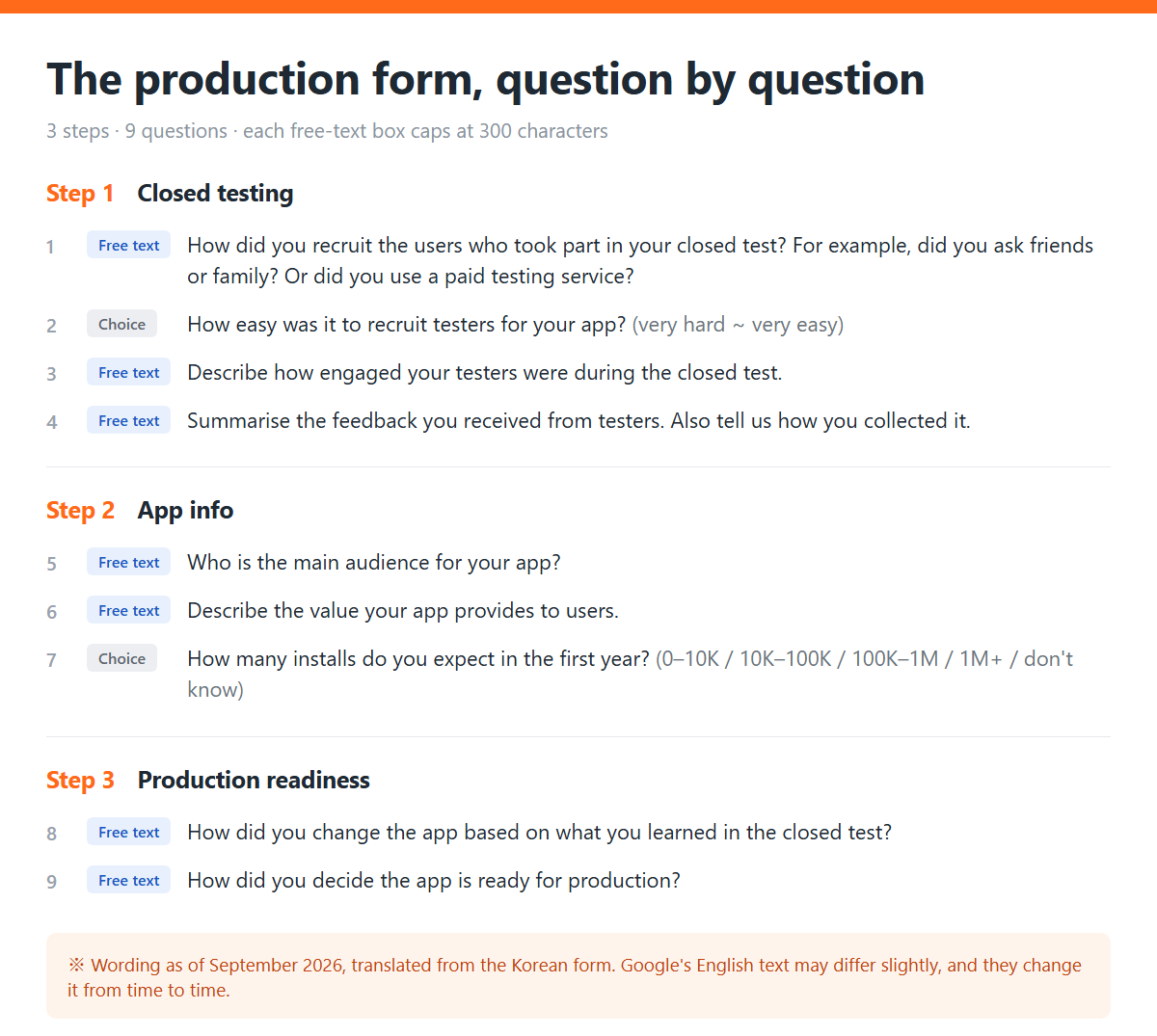
The button opens a three-step form. Nine questions, and every free-text box is capped at exactly 300 characters. Two are multiple choice. Below is each question in full — translated from the Korean form, so Google's own English wording may differ slightly.
Step 1 · Closed testing
- How did you recruit the users who took part in your closed test? For example, did you ask friends or family? Or did you use a paid testing service?
- How easy was it to recruit testers for your app? (very hard / hard / neutral / easy / very easy)
- Describe how engaged your testers were during the closed test. Tell us whether testers used all of the app's features, and whether the way they used it matches how you expect real users to use it. If it does not match, explain what differences you expect.
- Summarise the feedback you received from testers. Also tell us how you collected it.
Step 2 · App info
- Who is the main audience for your app?
- Describe the value your app provides to users.
- How many installs do you expect in the first year? (0-10K / 10K-100K / 100K-1M / 1M+ / don't know)
Step 3 · Production readiness
- How did you change the app based on what you learned in the closed test?
- How did you decide the app is ready for production?
Questions 4 and 8, in bold, are where it is actually decided. The rest you can write without stopping if you built the app.
Question 3 is the awkward one if you found your testers by trading. It asks whether their usage matches what real users would do, and to explain the difference if not. Honesty reads better here — saying developers tested each other and how that differs from real use holds together better than an invented sentence.
Your answers are not shown on the Play listing. The form says so on screen, so there is no reason to write them like marketing copy.
Why those two are hard
Two weeks later, "what feedback did I get" usually returns nothing. So you write something plausible — "testers found the UI intuitive and offered a few suggestions". The person reading it sees a few hundred of those a day.
Compare:
"One tester said the features came at him all at once and he did not know where to start. I added a three-screen intro on first launch, and he has kept using it since that build."
One person, one change, what happened after. That shape cannot be invented.
So where do the answers come from
From what you wrote down. You do not compose them at the end; you retrieve what the 14 days left behind.
Three things are worth keeping.
- Who tested, and for how many days — per person, not "12 for 14 days"
- The feedback verbatim — do not summarise it
- What you replied — that reply is your answer to "what did you change"
The third one matters most. Reply to feedback when it arrives and there is nothing to reconstruct later.
Nobody opens it all 14 days, by the way
Across 48 finished trades we measured, testers opened the app on 8.8 of 14 days on average. Five of 48 hit all 14. One never opened it at all.
So you do not need to claim your testers used it every day. Google counts how long they stayed opted in, not how often they opened it — see what Google actually checks.
If you get rejected, do you start over
No. A rejection means you apply again; it does not un-enrol your testers. They are still opted in and the days keep counting. Fill in what was thin and submit again.
Google changes this form regularly. The list above is as of September 2026 and the exact wording varies by account.